


Sotol Romo Is Redefining Mexican Luxury and Elevating Northern Mexico
- Tyzza Macias

- Feb 13
- 3 min read
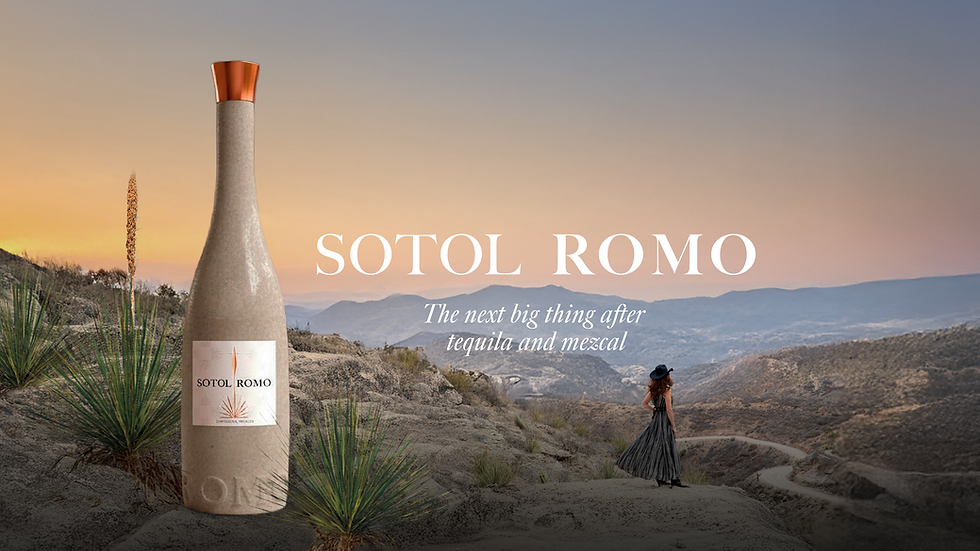
In a week when the Super Bowl transformed San Francisco into a global arena of celebrity endorsements and high-budget brand theatrics, a different kind of debut quietly carried historic weight.
Sotol Romo, an ultra premium Mexican spirit made from 100 percent Dasylirion, officially launched during Super Bowl Week. The moment was strategic. The setting was global. But the story reaches far beyond a bottle.
For decades, the world’s understanding of Mexican spirits has centered on tequila and mezcal. Jalisco and Oaxaca became synonymous with craftsmanship, export power, and luxury positioning. Northern Mexico, particularly Chihuahua, remained largely outside that international spotlight.
That absence was not a lack of heritage. It was a lack of amplification. Sotol Romo enters the conversation determined to shift that geography.
Produced in Chihuahua, the spirit is crafted as Sotol 100% Puro from 100 percent Dasylirion cedrosanum, a wild desert plant native to the Sierra Madre that takes 15 to 20 years to mature. It is not agave. It grows in harsher terrain, slowly and deliberately, surviving where little else does. During those years, the plant develops its sugars naturally, requiring far less manipulation after distillation and no additives.
The result is organic, sustainable, artisanal, kosher, and additive-free. Crafted with just plant and water, the spirit reflects something deeper than purity. It reflects patience.

“Sotol Romo is a treasure of the Sierra Madre,” said Claudia Romo Edelman, Founder and CEO of Sotol Romo, a globally recognized marketer, mobilizer, and brand builder. “It comes from a plant that survives where little else does and grows slowly under the harshest conditions. Like great wine or diamonds, the more challenging the nature is, the more exceptional the result. I’m proud to introduce a pure, elegant spirit from northern Mexico to a global consumer who wants the best and what comes next.”
Romo Edelman is not entering the premium spirits industry as a novelty. She enters as a builder of global narratives. In a category often dominated by celebrity-backed labels and legacy conglomerates, the presence of a Latina founder shaping a luxury brand from the ground up carries its own significance.
It is not just participation. It is authorship.
The liquid profile was perfected by Richard Betts, one of the most respected figures in modern Mexican spirits. His assessment distinguishes sotol not as an offshoot of mezcal or tequila, but as its own refined expression.
“Compared to mezcal, sotol is lighter, more elegant, and less smoky or forceful. It allows more space for subtle flavors and balance. Compared to tequila, it feels more aromatic and refined, with a clearer expression of the land. Mezcal was the dress rehearsal. Sotol can be bigger, faster,” said Betts.
If tequila globalized Mexican spirits and mezcal elevated them into artisanal luxury, sotol now emerges as the potential third pillar. Market intelligence estimates the global sotol market revenue at 1.2 billion dollars, with expectations to triple by 2033 at a CAGR of 13.5 percent. Yet beyond projections and percentages lies something more meaningful.
For U.S. Latinx consumers, the rise of sotol reflects a broader evolution. As spending power grows and cultural influence expands, there is a deepening desire for products that feel both authentic and elevated. Modern Latin luxury is no longer defined externally. It is being authored from within.
Sotol Romo was created as a joint venture with Casa Komos Brands Group, whose distribution footprint spans 50 states and 40 countries. The infrastructure signals ambition. But the vision remains grounded in place.
“My dream is to make Sotol known around the world, not in decades but in years, and to help bring jobs and opportunity to little-known and still undiscovered regions of Northern Mexico, the way tequila and mezcal did for the south,” concluded Romo Edelman.
The statement reframes the brand as more than a commercial venture. It becomes an economic proposition. If tequila transformed Jalisco and mezcal elevated Oaxaca, sotol may offer northern Mexico its own chapter of global recognition.
Sotol Romo enters the market priced at 79 dollars for Blanco and 89 dollars for Reposado, with commercial expansion planned for New York and Texas in Spring 2026. Whether the category scales rapidly or gradually, the symbolic shift has already occurred.
Northern Mexico is stepping into its moment. A Latina founder is redefining the language of luxury. Mexican excellence continues to command its place on the global stage. This is not merely a launch. It is a recalibration of who sets the standard for refinement.


